
An Arboricultural Impact Assessment, usually shortened to AIA, is a report used to assess how a proposed development could affect trees on or close to a site. It is commonly prepared as part of the BS5837 planning process when trees may influence the design, construction or future use of a development.
For homeowners, architects, developers and planning consultants in London, an AIA can be an important part of a planning application. It explains which trees may be retained, where conflicts could occur and what measures may be needed to reduce harm.
The assessment is usually based on information gathered during a BS5837 tree survey for a planning application. It then compares the proposed development layout with the tree constraints identified during that survey.
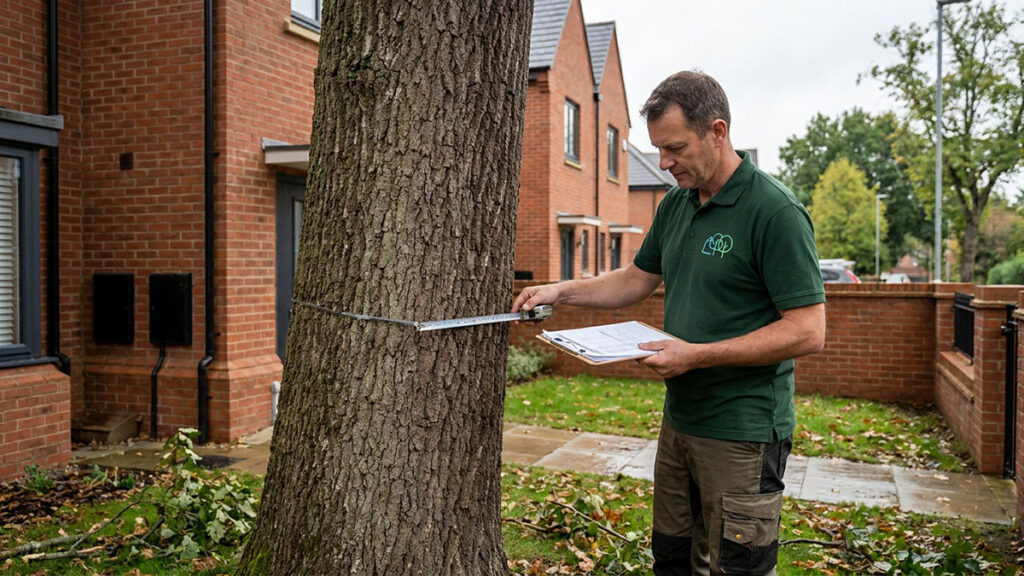
What Is an Arboricultural Impact Assessment?
An Arboricultural Impact Assessment is a technical review of the likely effects of development on existing trees. It considers both direct impacts, such as removing a tree to make space for a building, and less obvious impacts, such as excavation close to roots, changes in ground levels, new hard surfaces, access routes or pressure for future pruning.
The assessment should be proportionate to the project. A small residential extension may require less detail than a major development, but the purpose remains the same: to show how trees have been considered within the design.
Greater London Authority data estimates that tree canopy covers around 19.6% of London, which helps explain why tree protection can be an important planning consideration.
How Does an AIA Fit Into a BS5837 Tree Survey?
An AIA is normally one stage within a wider BS5837 assessment. The process often starts with a tree survey that records the species, size, condition, age class and quality of trees on and around the site. The consultant then prepares a Tree Constraints Plan showing features such as canopy spread and Root Protection Areas.
Once the proposed layout is available, the consultant compares it with those constraints. The AIA identifies where buildings, foundations, access roads, drainage, services or demolition works may interact with trees.
If you are still at the early planning stage, our guide to what a tree survey for planning permission should include explains the main reports and drawings that may be requested.
What Does an Arboricultural Impact Assessment Consider?
A good AIA looks at the full relationship between the proposed development and the trees affected by it, rather than simply listing which trees are present.
Tree Retention and Removal
The assessment identifies trees that can be retained and any that may need removal. Tree quality, condition, expected useful life and contribution to the site are considered alongside the proposed layout.
Root Protection Areas
Root Protection Areas, or RPAs, show the area around retained trees that should normally be protected from damaging construction activity. The AIA checks whether foundations, excavation, surfacing, utilities or access routes enter these areas.
Canopy and Building Conflicts
The assessment considers whether buildings are too close to retained canopies. It may also consider shading, branch clearance and whether future occupants could place pressure on trees through repeated pruning requests.
Changes to Ground Levels and Surfaces
Raising or lowering soil levels around trees can affect roots. New patios, roads, parking areas and other hard surfaces may also change soil conditions. An AIA identifies these potential conflicts so they can be addressed before works begin.
Mitigation and Replacement Planting
Where tree loss or disturbance cannot be avoided, the AIA may recommend mitigation. This can include changes to the layout, specialist construction techniques, protective measures or replacement tree planting.
When Is an Arboricultural Impact Assessment Required in London?
An AIA may be requested where a proposed development could affect trees on the application site or trees on neighbouring land. The exact information required depends on the local planning authority, the scale of development and the relationship between the proposal and nearby trees.
It is commonly relevant for new builds, extensions, basement works, redevelopment, demolition, new access routes, parking areas, level changes and projects where services or drainage pass close to trees.
It may also be particularly important where trees are protected by a Tree Preservation Order or where the site is within a conservation area. Government guidance explains how Tree Preservation Orders and conservation area tree protections operate in England.
Not every project needs the same level of information. A scheme with greater tree impact may require an AIA, Tree Protection Plan and Arboricultural Method Statement.
What Is the Difference Between an AIA and an Arboricultural Method Statement?
The two documents are related, but they perform different jobs.
The AIA identifies and assesses the effects of the proposed development on trees. It answers questions such as: Which trees will be affected? Where are the conflicts? Can the impacts be avoided or reduced?
An Arboricultural Method Statement, or AMS, explains how retained trees will be protected during construction. It may cover protective fencing, ground protection, demolition near trees, specialist excavation, site access, material storage and supervision.
Our guide to Arboricultural Method Statements for planning applications explains this construction-stage document in more detail.
Why Should an AIA Be Prepared Early?
Tree constraints are easier to manage before the design is fixed. Early advice shows where important trees, canopies and RPAs are located before the final position of buildings and access routes is decided.
This can reduce the risk of redesign later and gives the planning authority a clearer explanation of how the proposal responds to existing trees.
For developments where trees are likely to influence the layout, an early BS5837 tree survey and report in London can provide the information needed to guide the design from the outset.
What Happens After the Arboricultural Impact Assessment?
Once the AIA is complete, its findings may be submitted with the planning application alongside drawings and other arboricultural documents. Depending on the proposal, these may include a Tree Protection Plan, tree works schedule or Arboricultural Method Statement.
The local planning authority can then review how trees will be affected and protected. If the design changes, the AIA may need to be updated to reflect the final scheme.
Arboricultural Impact Assessments in London
London Tree Survey Consultants prepares BS5837 tree surveys, Arboricultural Impact Assessments and related planning reports for residential and commercial development projects across London.
If your planning application includes trees on or close to the site, arranging the assessment early can identify constraints before they become a problem. A clear AIA records tree impacts, mitigation and the measures needed to retain suitable trees.