
If you’re submitting a planning application in London, there’s a good chance you’ll be asked for a tree survey and supporting arboricultural report. This often happens when trees are on your site, near your boundary, or could be affected by demolition, construction, foundations, access, or service runs.
At London Tree Survey Consultants, we focus on making the process straightforward: clear site work, clear reporting, and the right planning documents to help your application move forward.
Why London planning teams ask for a tree survey report
Local Planning Authorities (LPAs) use tree survey reports to understand constraints before they approve development. They need evidence that your design considers tree canopies, rooting environments, and long-term tree retention where reasonable.
A BS5837-aligned survey also helps confirm whether protected trees (for example, trees covered by a Tree Preservation Order or in a Conservation Area) are being appropriately considered in the design and build approach.
What is a “tree survey for planning permission” in practice?
For most planning applications, what people call a “tree survey” is a package of information prepared in line with BS5837:2012 (Trees in Relation to Design, Demolition and Construction).
Your planning package may include some or all of the following: a tree schedule, constraints plans, impact assessment and method statement, and a tree protection plan.
The goal of the report
The goal is not just to list trees, but to reduce uncertainty for planners by showing:
- What trees exist and their quality,
- What the development could affect,
- What will be retained or removed (and why),
- And exactly how retained trees will be protected through construction.
The key functions of a planning tree survey report
Below is a practical checklist of the core functions your report should deliver.
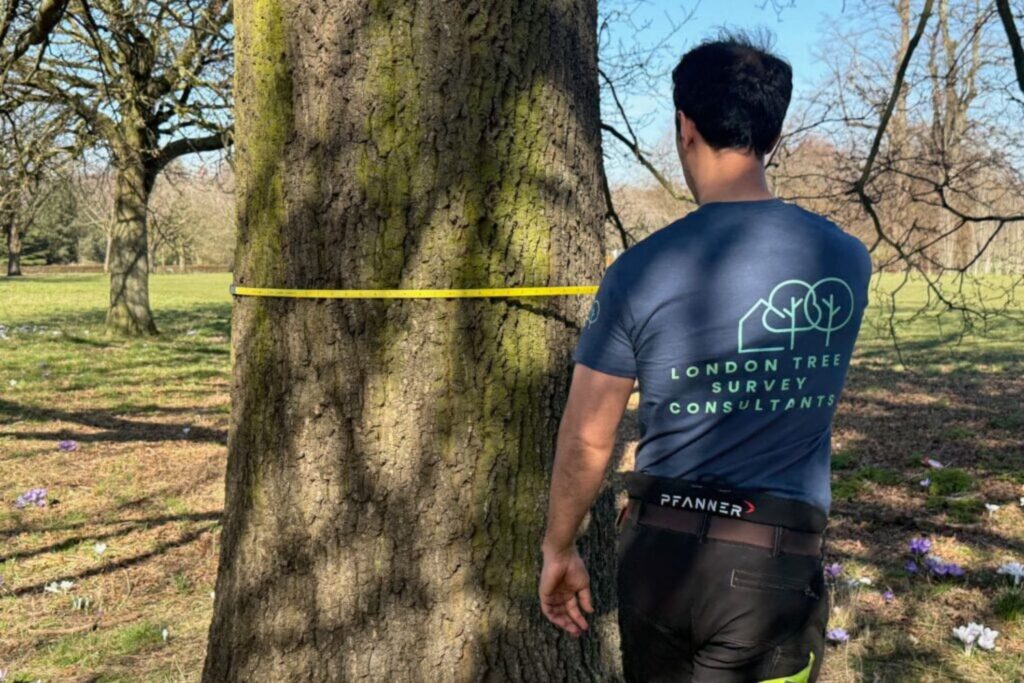
Identify and record every relevant tree
A planning report should identify trees:
- Within the site, and
- Near enough to be affected (often adjacent or overhanging trees, depending on the proposal).
- This is usually presented in a (Tree Schedule) that records species, dimensions, age class, condition, remaining contribution, and recommendations.
Provide accurate tree locations and mapping for design use
Planning officers and design teams need trees mapped properly so drawings can be coordinated.
A Tree Survey Plan (or similar) provides plotted locations and references, allowing constraints to be overlaid in CAD and used during design development.
Calculate Root Protection Areas so foundations and services can be assessed
One of the biggest planning pinch-points is below-ground conflict.
A strong report clearly sets out Root Protection Areas (RPAs) so designers can check:
- Foundation types
- Drainage routes
- Service trenches
- Levels changes
- New surfacing and access.
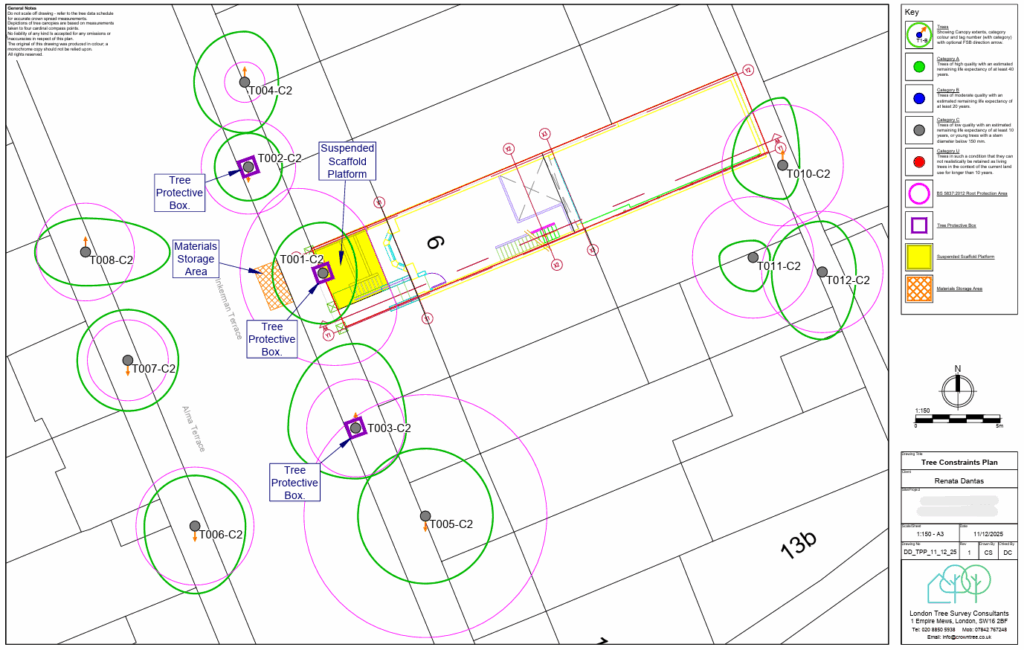
Produce a Tree Constraints Plan to inform layout decisions early
A Tree Constraints Plan (TCP) typically shows RPAs, canopy spreads, and other constraints so the design can respond before it becomes fixed.
This is one of the fastest ways to prevent redesign and resubmission later.
Explain how the proposal affects trees
Where impacts are unavoidable, the planning authority will expect them to be described and justified.
Typical impacts a report should address
- Direct tree removals
- Pruning requirements
- Encroachment into RPAs
- Shading and future pressure to prune
- Access and construction footprint
- Demolition effects on rooting areas
This is usually set out within an Arboricultural Impact Assessment (AIA) as part of the BS5837 suite.
Submit a practical method statement that contractors can follow on site
A report should not stop at retained tree.
A robust Arboricultural Method Statement (AMS) sets out how retained trees will be protected during the build, including:
- Sequencing
- Protective fencing requirements
- Ground protection
- Special construction methods where works are close to RPAs
Include a Tree Protection Plan that can be conditioned
LPAs often condition approvals with tree protection requirements. A clear Tree Protection Plan (TPP) makes it easy for planners to attach conditions and for site teams to comply.
This is particularly important on tight London sites where storage, access and working areas are constrained
Reduce planning risk by pre-empting common validation issues
A planning-focused report should help avoid:
Missing plans.
- Unclear numbering between schedule and drawings.
- No RPA shown (or shown inconsistently).
- No protection methodology.
- Unexplained removals,
- Drawings not matching the proposed layout.
This is where a planning-experienced consultant adds real value, because the aim is fewer queries and fewer delays.
When you should commission the report
The best time is early—before your drawings are final.
If trees are identified late, the result is often redesign, foundation changes, or planning objections that could have been avoided.
What makes a strong London planning submission
In London, planning outcomes are often decided on clarity as much as content.
Short, unambiguous recommendations. Clean plans. Consistent tree numbering across every document. A method statement that can be actioned on site.
That combination makes it easier for planners to say “yes”, and easier for contractors to build without harming retained trees.
Conclusion: Get the right tree survey report first time
A tree survey for planning permission is not a box-ticking exercise. It is a decision-making tool that shows planners how your proposal respects trees, manages constraints, and protects what should be retained.
If you want your planning submission to move faster, focus on the key functions above: accurate data, clear constraints mapping, justified impacts, and a buildable protection methodology aligned with BS5837.
To arrange a BS5837 or tree condition survey in London, contact London Tree Survey Consultants today for expert guidance and a free quote.