
If you’ve already commissioned a BS5837 tree survey for your London development, you might assume your arboricultural paperwork is complete. In many cases, it isn’t. Local planning authorities frequently come back asking for an Arboricultural Method Statement (AMS) before they’ll validate or determine an application and not knowing what this document is, or why it’s separate from your tree survey, is one of the most common causes of planning delay we see at London Tree Survey Consultants.
This guide explains exactly what an AMS is, what it contains, when you need one, and how it fits alongside your tree survey for planning permission.
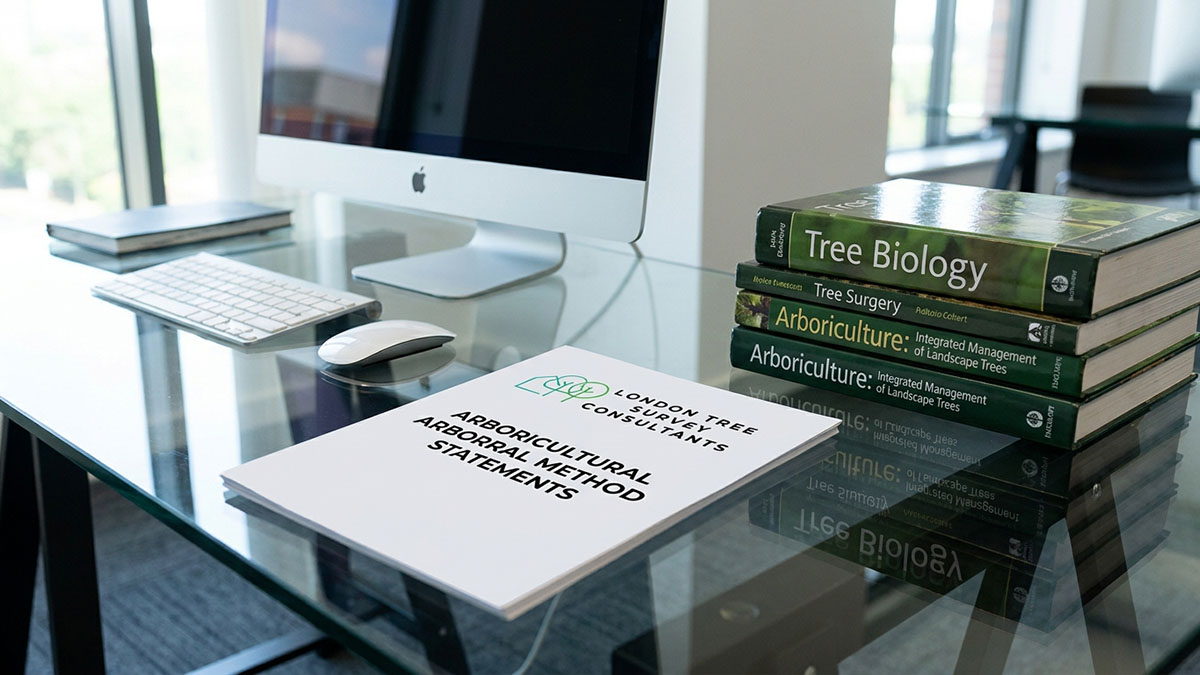
What Is an Arboricultural Method Statement?
An Arboricultural Method Statement is a technical document that sets out exactly how trees on or near a development site will be physically protected throughout construction. Where a tree survey records what trees exist, and an Arboricultural Impact Assessment (AIA) evaluates how a proposed design affects them, the AMS answers the practical question: how will protection actually be implemented on site, day to day?
It’s a working document for contractors as much as it is a planning submission. A well-written AMS tells site teams precisely where fencing goes, what activities are banned within root protection areas, and who is responsible for checking compliance.
How an AMS Differs From a Tree Survey and AIA
These three documents are often confused, but each has a distinct role:
- Tree Survey: Records species, dimensions, condition and retention category for every relevant tree, in line with BS5837:2012.
- Arboricultural Impact Assessment: Assesses how the proposed design and construction activity will affect those trees, and identifies any conflicts.
- Arboricultural Method Statement: Specifies the practical protection measures, construction methodology, and monitoring arrangements needed to deliver the AIA’s recommendations.
In short, the survey identifies the trees, the AIA identifies the risks, and the AMS solves them.
What Does an Arboricultural Method Statement Include?
A compliant AMS prepared to BS5837:2012 standards typically covers:
- A Tree Protection Plan showing the position of protective fencing and ground protection relative to each Root Protection Area (RPA)
- Specification of fencing type, materials and construction (commonly Heras panel and scaffold-pole barriers)
- Details of any working methods required within an RPA, such as hand-digging, no-dig surfacing, or directional drilling for services
- Arrangements for site inductions, signage and contractor briefings
- A schedule of arboricultural supervision, confirming when a qualified arboriculturist must be present during works
- Procedures for managing materials storage, vehicle access, and excavation near retained trees
- A monitoring and reporting structure for the local authority’s tree officer
Root Protection Areas and Why They Matter
The RPA calculation underpins almost every measure in an AMS. Under BS5837 methodology, the RPA is calculated as a circular area with a radius equivalent to 12 times the tree’s stem diameter, meaning a tree with a 125cm diameter trunk requires a protected radius of around 15 metres, an area that can significantly constrain a development site. Getting this calculation wrong, or failing to specify how construction will avoid it, is one of the most common reasons councils reject or request revisions to a method statement.
When Do London Councils Require an AMS?
Most London boroughs require an AMS where a development site contains trees protected by a Tree Preservation Order, sits within a conservation area, or simply has trees close enough to the works to be affected by construction activity. This aligns with the framework set out in BS5837:2012, which most planning authorities reference directly when assessing applications involving trees.
It’s worth noting that requirements differ slightly between full planning applications and householder applications, so the level of detail expected in your AMS can vary depending on the type and scale of your project. If your site includes trees covered by a TPO, expect councils to apply the fuller, more detailed requirements regardless of the application type.
What Happens If You Don't Submit One?
Submitting a planning application without a required AMS rarely results in outright refusal on its own, but it almost always causes delay. Planning officers will typically return the application as invalid, or impose a pre-commencement condition requiring the AMS before any work can start, which can stall a project by weeks while a suitably qualified arboriculturist is instructed and the document is prepared, reviewed and re-submitted.
Who Can Prepare an Arboricultural Method Statement?
An AMS should be prepared by a suitably qualified arboriculturist with demonstrable experience in trees and construction interaction, not generated generically from a template. Councils’ tree officers will scrutinise whether the protection measures are realistic for the actual site conditions, contractor methods, and tree species involved. A generic or poorly specified AMS is one of the most frequent reasons for officer pushback and further information requests.
Combining Your AMS With a Root Protection Area Plan
Because RPAs sit at the heart of nearly every protection measure, your AMS should be cross-referenced with a clear Root Protection Area plan, ensuring fencing lines, no-dig surfacing zones and access routes are all mapped against the same baseline data used in your original tree survey.
Getting Your AMS Right the First Time
The most efficient route through planning is to commission your tree survey, AIA and AMS together, from a consultant who understands how London boroughs assess these documents in practice. This avoids the back-and-forth of piecemeal submissions and ensures your protection measures are realistic, deliverable, and consistent across all three reports.
According to the Royal Institution of Chartered Surveyors, trees are treated as a material consideration in UK planning decisions, meaning their presence can directly influence whether permission is granted, making a properly specified AMS far more than a box-ticking exercise.
If you’re preparing a planning application in London and need an Arboricultural Method Statement prepared alongside your tree survey, our team can produce both as a single, coordinated package designed to meet borough requirements first time. Learn more about our BS5837 tree survey and reporting service or get in touch to discuss your site.