
When a storm brings down a branch onto your roof, or cracks start appearing in a wall after a dry summer, your first call is usually your insurer. What many London homeowners don’t realise is that a professional tree survey or arboricultural report is often the deciding factor in whether that claim is settled quickly, partially, or disputed for months. This guide explains how tree survey evidence supports insurance claims after both storm damage and subsidence, and what to do if you suspect a tree is involved.
Why Insurers Ask for Tree Evidence
Subsidence and storm-related claims are rarely straightforward. Insurers need to establish cause before they pay out, and where a tree is anywhere near the affected property, they will typically want independent evidence of its condition, species, root spread and proximity to the structure. Without this, claims can stall while loss adjusters request further investigation or be rejected outright if liability can’t be clearly established.
This is a different need to the preventative tree survey most homeowners are familiar with. If you haven’t already, our guide on how tree surveys help prevent property subsidence covers the proactive side of managing risk before damage occurs. This article focuses on what happens after damage has already been done, and how a report supports your claim.
Subsidence Claims: A Significant and Growing Issue
Subsidence is one of the most common tree-related insurance issues in the UK, and it’s a costly one. According to the Association of British Insurers, subsidence-related claims totalled £153 million in the first half of 2025 alone, with insurers supporting almost 9,000 households at an average payout of £17,264 per claim. On clay-rich soils, which cover much of London, trees and vegetation are linked to over 65% of subsidence damage cases, making arboricultural evidence central to how these claims are assessed.
What a Tree Survey Report Provides for a Claim
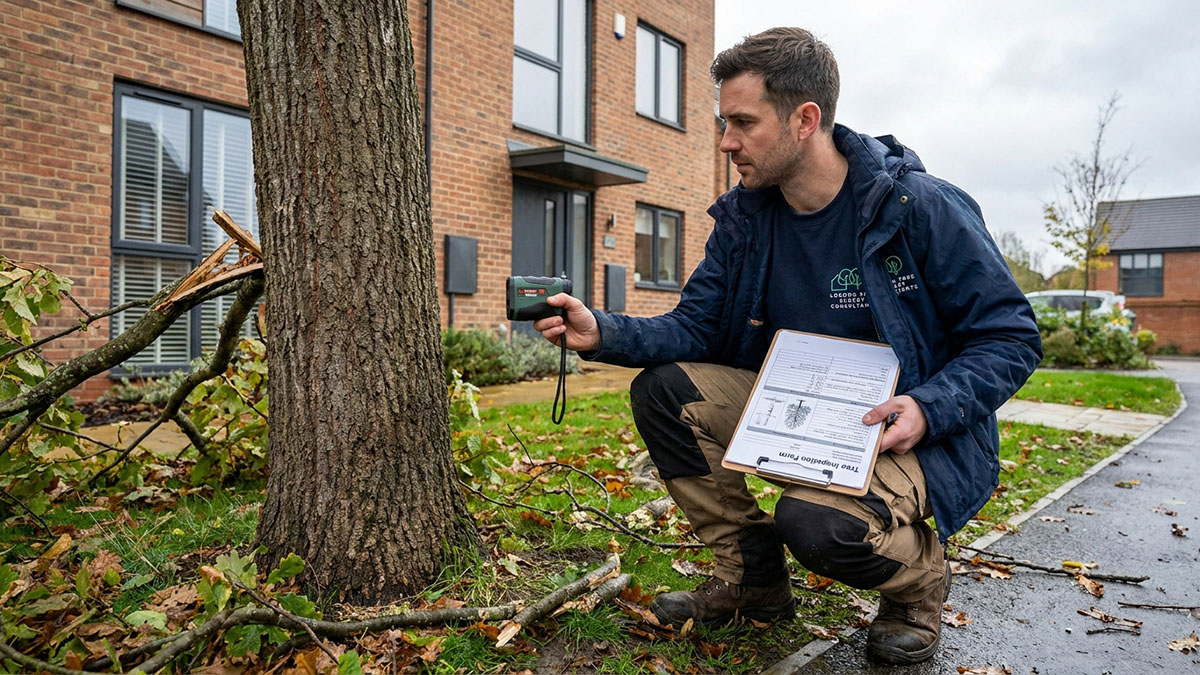
A tree report prepared specifically for insurance purposes goes beyond a standard condition assessment. It typically includes:
- Species identification and an assessment of the tree’s water demand, since some species (oak, willow, poplar) are far more associated with clay shrinkage than others
- Distance from the property and an assessment of root spread relative to the foundations
- Condition and structural assessment, particularly relevant for storm damage claims where branch or whole-tree failure is the cause
- Ownership clarification, whether the tree sits on your land, a neighbour’s, or is a council-owned street tree, which directly affects liability
- Photographic evidence and a clear, dated written record that can be submitted directly to loss adjusters or used in dispute resolution
Storm Damage: A Different Evidence Requirement
Storm claims are usually more time-pressured than subsidence claims, since there’s often an immediate safety issue alongside the insurance process. Here, the priority is documenting the condition of the tree before and where possible, after failure including any pre-existing defects such as decay, deadwood or poor structural form that may indicate the tree should have been identified as a risk earlier. This is particularly relevant if a neighbouring tree caused the damage, as it can clarify whether reasonable care was taken by its owner. For background on how risk is assessed before failure occurs, see our guide on tree safety reports for London property owners.
When Should You Commission a Report?
Ideally, evidence should be gathered as soon as possible after damage occurs and before any remedial works take place, since removing or pruning a tree before it has been assessed can destroy the evidence your claim depends on. If your insurer has already instructed a loss adjuster, it’s still worth commissioning an independent arboricultural report, adjusters work for the insurer, and an independent report ensures your interests are properly represented, particularly where liability is contested.
What If the Tree Belongs to a Neighbour or the Council?
Liability for tree-related damage generally sits with the tree’s owner, not the affected property owner. If a neighbour’s tree or a council street tree is implicated, an independent report becomes even more important, since it provides objective evidence you can present to the relevant party’s insurer rather than relying solely on their own assessment. Disputes involving council-owned trees can be slow to resolve, so early, well-documented evidence significantly strengthens your position.
Avoiding Common Pitfalls
A few mistakes can weaken an otherwise valid claim:
- Removing the tree too soon. This can be seen as destroying evidence and may complicate liability assessment.
- Relying only on photos. Insurers generally expect a written report from a qualified arboriculturist, not informal photographic evidence alone.
- Delaying action. Subsidence in particular can take months to fully develop, and gaps in your evidence timeline can be used to challenge causation.
- Assuming all cracking is subsidence-related. Not every crack is caused by a tree, and a proper assessment avoids unnecessary tree removal recommended on incomplete evidence.
Get Independent Evidence You Can Rely On
Whether you’re dealing with a storm-damaged tree or a developing subsidence claim, an independent, professionally prepared report gives you a clear, evidence-based position to bring to your insurer. It can mean the difference between a claim that’s settled promptly and one that drags on for months over disputed causation.
If you need a tree report to support an insurance claim in London, our team can carry out a site assessment and provide clear, evidence-based documentation suitable for submission to insurers and loss adjusters. Find out more about our tree safety report service or get in touch to discuss your situation.