
BS5837 tree surveys are an important part of the planning and development process for many construction projects across London and the UK. When trees are located on or near a proposed development site, local planning authorities often require detailed arboricultural assessments before planning approval is granted.
A BS5837 survey helps developers, architects and planning consultants understand how existing trees may affect site design, construction methods and long term development plans.
Professional tree surveys identify important trees for retention, assess tree condition and help reduce the risk of unnecessary tree loss during construction projects.
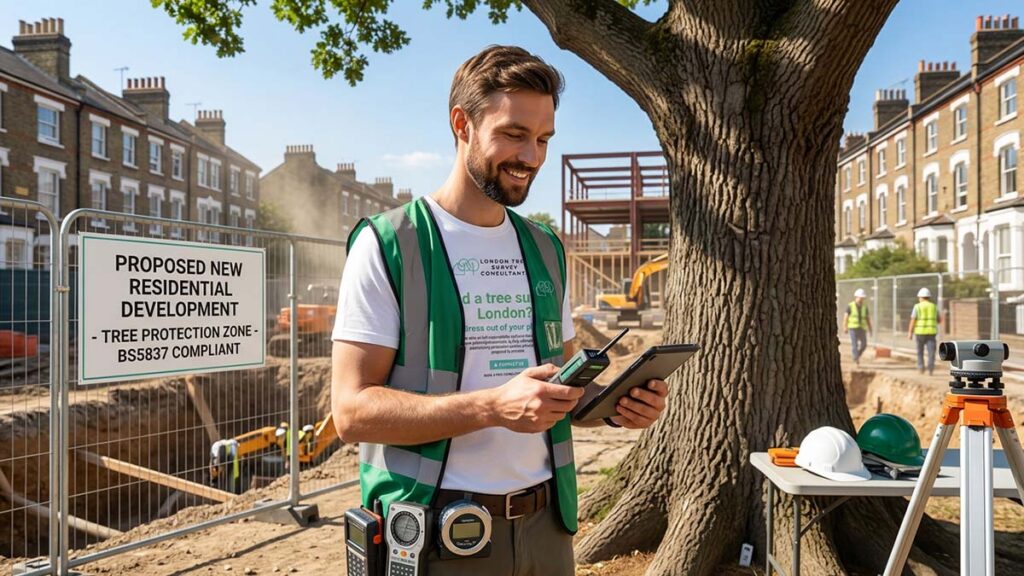
What Is a BS5837 Tree Survey?
A BS5837 tree survey is carried out in accordance with the British Standard BS5837:2012, titled:
“Trees in relation to design, demolition and construction – Recommendations”
The survey provides detailed information about trees located on or adjacent to development sites and helps guide planning and construction decisions.
BS5837 surveys are commonly required for:
- New build developments
- House extensions
- Flat developments
- Commercial construction projects
- School developments
- Road and infrastructure projects
- Site redevelopments
- Housing developments
The survey forms part of the wider planning application and arboricultural assessment process.
Why BS5837 Surveys Are Important for New Build Projects
Trees can significantly influence the layout and design of a development site.
Failing to properly assess trees early in the planning process can result in:
- Planning delays
- Additional redesign costs
- Damage to protected trees
- Legal complications
- Construction restrictions
- Tree related safety concerns
A professional BS5837 tree survey helps developers identify potential issues before submitting planning applications.
The survey also supports sustainable development by helping retain suitable trees where possible.
What Happens During the Site Inspection?
The first stage of a BS5837 tree survey is the on site inspection.
An arboricultural consultant visits the site to inspect, record and assess all relevant trees that may be affected by the proposed development.
Tree Identification
Each tree is identified by species and assigned a reference number for reporting and mapping purposes.
Tree Measurements
The survey records important tree dimensions including:
- Tree height
- Stem diameter
- Crown spread
- Crown clearance
- Branch spread direction
These measurements help determine how trees may interact with the proposed development.
Tree Condition Assessment
Surveyors assess the overall health and structural condition of each tree.
The inspection may identify:
- Deadwood
- Structural defects
- Decay
- Weak branch unions
- Disease
- Storm damage
- Root issues
Tree Category Grading
Trees are graded according to their quality and value using BS5837 categories:
- Category A – High quality trees
- Category B – Moderate quality trees
- Category C – Low quality trees
- Category U – Trees unsuitable for retention
These categories help guide planning decisions and tree retention strategies.
Root Protection Area Assessment
One of the most important parts of a BS5837 survey is the Root Protection Area assessment.
The Root Protection Area, often called the RPA, identifies the minimum area around a tree that should remain protected during construction.
The RPA helps reduce risks such as:
- Root damage
- Soil compaction
- Tree instability
- Long term tree decline
Protecting root systems is essential for maintaining tree health during and after construction works.
Tree Constraints Plan Preparation
Following the survey inspection, arboricultural consultants prepare a Tree Constraints Plan.
This plan shows:
- Tree locations
- Crown spreads
- Root Protection Areas
- Tree categories
- Existing site constraints
Architects and planning consultants use this information when designing the development layout.
The Tree Constraints Plan helps determine where buildings, roads, drainage systems and service routes can be positioned safely.
Arboricultural Impact Assessment
For many developments, a BS5837 survey is followed by an Arboricultural Impact Assessment.
This report evaluates how the proposed construction may affect retained trees and identifies measures required to reduce damage.
The assessment may consider:
- Excavation works
- Foundation design
- Service installation
- Access routes
- Level changes
- Demolition works
- Construction traffic movement
The goal is to balance development requirements with responsible tree protection.
Tree Protection Recommendations During Construction
BS5837 surveys often include recommendations for protecting retained trees throughout the construction phase.
Protection measures may include:
Protective Fencing
Temporary fencing is installed around Root Protection Areas to prevent machinery access and accidental damage.
Ground Protection Systems
Special protection surfaces may be required where temporary access routes pass near trees.
Special Construction Methods
In sensitive areas, no dig construction techniques or alternative foundation systems may be recommended.
Arboricultural Monitoring
Some developments require ongoing supervision by an arboricultural consultant during key stages of construction.
When Decay Detection Investigations May Be Needed
If trees show signs of structural weakness or internal defects, additional investigations may be recommended.
Advanced equipment such as:
- Picus Sonic Tomography
- IML Resi drilling
may be used to assess internal decay and structural stability.
These investigations can help determine whether trees are suitable for retention near proposed buildings and public spaces.
How BS5837 Surveys Help Planning Applications
Planning authorities across London frequently require BS5837 surveys as part of planning submissions.
A professional survey helps demonstrate that:
- Trees have been properly assessed
- Suitable protection measures are proposed
- Important trees are being considered during site design
- Construction impacts have been evaluated
Well prepared arboricultural reports can help reduce planning delays and improve communication with local planning departments.
Who Needs a BS5837 Tree Survey?
BS5837 surveys are commonly required by:
- Property developers
- Architects
- Planning consultants
- House builders
- Commercial developers
- Schools and universities
- Housing associations
- Local authorities
Even smaller residential developments may require tree surveys if trees are located close to the proposed works.
Professional BS5837 Tree Surveys in London
BS5837 tree surveys are a key part of responsible development planning across London. They help identify valuable trees, reduce construction related damage and support planning applications for new build projects.
Professional arboricultural consultants provide detailed surveys, Tree Constraints Plans, Arboricultural Impact Assessments and construction phase guidance to help developers manage trees responsibly throughout the planning and building process.
Whether you are planning a residential development, commercial project or site redevelopment, a professional BS5837 survey can help support safer and more efficient project delivery.