
Trees across London provide environmental and aesthetic benefits, but like all living organisms they can develop structural problems over time. One of the most serious issues affecting mature trees is internal decay.
Tree decay can weaken the structure of a tree without obvious external signs. This means that a tree may appear healthy while its internal wood structure is gradually deteriorating.
Tree decay detection allows arboricultural consultants to identify these hidden problems before they lead to branch failure or tree collapse. By detecting decay early, property owners can take appropriate steps to manage potential risks while preserving healthy trees whenever possible.
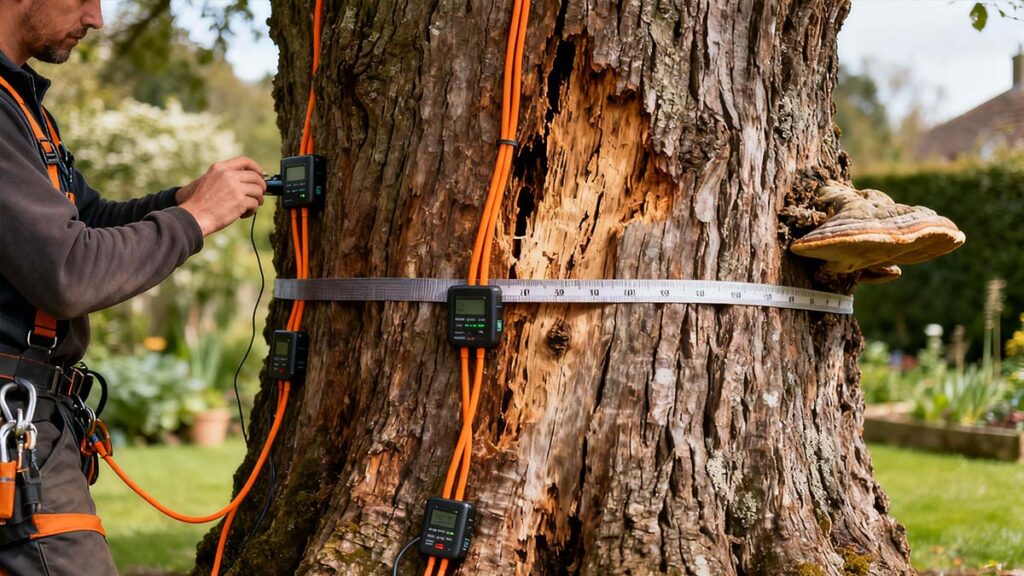
What Is Tree Decay Detection?
Tree decay detection is a specialised diagnostic process used to identify internal structural damage within a tree.
Unlike a standard visual inspection, decay detection uses professional equipment to examine the internal condition of the tree trunk or major branches.
The aim is to determine whether decay is present and how much of the tree’s structural strength may be affected.
This information allows arborists to assess whether a tree remains stable or whether maintenance work, monitoring or removal may be necessary.
Decay detection is particularly useful when trees are located close to buildings, roads or areas used by the public.
Why Tree Decay Can Be Difficult to Identify
Many types of decay develop inside the tree where they cannot easily be seen from the outside. As a result, visual inspection alone may not always reveal the full condition of the tree.
Professional diagnostic testing provides additional information that helps arborists make more accurate assessments.
Hidden Internal Decay
Internal decay often begins within the heartwood of the tree. This type of decay may progress slowly while the outer surface of the tree continues to look healthy.
Over time the internal structure may weaken significantly even though the tree appears stable from the outside.
Decay detection testing helps identify these hidden structural weaknesses.
Fungal Infections and Disease
Many types of tree decay are caused by fungal organisms that break down wood tissue.
Fungal fruiting bodies may appear on the trunk or near the base of the tree, which can indicate the presence of decay within the tree structure.
However, the visible fungus may only represent a small part of the internal problem.
Specialist testing helps determine the extent of decay within the trunk.
Structural Weakness
As decay spreads through the internal wood of a tree, its structural strength can gradually decline.
This may increase the risk of branch failure or stem collapse during strong winds or storms.
Decay detection testing helps arborists determine whether a tree remains structurally stable or whether risk management measures are required.
Technology Used for Tree Decay Detection
Modern arboricultural diagnostics use several specialised tools that allow consultants to examine tree structure with greater accuracy.
These technologies help assess internal decay without causing significant damage to the tree.
Resistograph Testing
A resistograph is a diagnostic tool that measures resistance while a very small drill passes through the wood.
Changes in resistance help identify areas where the wood may be decayed or weakened.
The resulting data allows arborists to assess the internal condition of the tree trunk.
Sonic Tomography
Sonic tomography uses sound waves to analyse the internal structure of a tree.
Sensors placed around the trunk measure how sound travels through the wood.
Areas affected by decay alter the speed of the sound waves, allowing specialists to create a visual map of the internal condition of the tree.
Visual Tree Assessment
Decay detection testing is usually combined with visual tree assessment.
An experienced arborist will examine the tree for external indicators such as:
- Cracks or cavities
- Fungal growth
- Deadwood
- Leaning stems
- Root damage
Combining visual inspection with diagnostic testing provides a more complete understanding of the tree’s condition.
When Tree Decay Detection Is Recommended
Tree decay detection may be recommended in several situations, particularly when trees grow close to buildings or public spaces.
Common situations include:
- Trees showing signs of decay or fungal growth
- Mature trees located near buildings or roads
- Trees with cavities or visible structural defects
- Trees affected by storm damage
- Trees involved in safety inspections or risk assessments
Testing helps determine whether the tree remains structurally sound or whether further action may be needed.
How Early Detection Helps Prevent Tree Failure
Early detection of decay allows arborists to recommend appropriate management strategies before serious structural failure occurs.
In many cases, trees with early stage decay can be safely managed through pruning, monitoring or other maintenance work.
Where structural weakness is more severe, removal may sometimes be necessary to protect people and property.
Professional decay detection helps ensure that decisions about tree management are based on accurate information rather than assumptions.